.
"Magic demands sacrifice, and so what heaven withholds, I take from hell."
Vignette
Mercenaries, condottieri, landsknecht– there’s a dozen words to try and dress up what you were: a career murderer. Things were so much more chaotic back then, though: the moon falling; the shelling and endless fire; the awful silence. So with the world torn asunder, maybe no one really blinked twice when they let you, a boy of just fourteen years old, stand shoulder-to-shoulder with men twice your age as you soldiered off to war’s ‘great adventure.’ As you charged unto the breach. You were good at what you did, after all, and besides: nothing made sense back then anyways. A lot of kids lived through the Calamity and had it far worse. The world needed order... and sacrifices had to be made.But no one expected your knack for ripping things from between worlds: for reaching into the Pit... and pulling them squirming and shrieking into the meat and noise of the Source. Peers pretended they didn’t notice the way your eyes grew a little more sunken every time. Superiors were happy to let you learn your own lessons and make your own mistakes, so long as you gave them that eager smile, so long as the killing continued.The problem with mistakes of these stripes is that they have a way of lingering and coming back again and again and again.


Untitled

Ser Solomon the Gold,
of the House of Page
| Gender | Cis male |
| Age | Twenties |
| Ethnicity | Kokkish Miqo'te |
| Sexuality | Femme pref, Polyam |
| Archetype | Well-meaning Demonologist |
| Society | The Order at Oldcross House |
Personality & Themes
Arcanima prodigy, but are demonologists meant to be this adorable; scholar of ‘Mathematics on Universal Structure’ and ‘Metaphysical Architecture & Sacred Forms’; oscillates between being a wet noodle; and unexpectedly competent; quietly thinks he’s hot shit (finger guns); protective of his occult ‘intellectual property’; uncomfortable political opinions about magocratic supremacy and arcane elitism; calm, reserved, and disciplined, until you start actually listening to him; subtly intimate and quietly intense; stares that last too long and blink too seldom; words that linger and are clinical only insofar as how they make you feel like he’s taking a scalpel to you; peeling you open, curious to find out what he’s working with; it doesn’t have to hurt; maybe it means he already likes you; he’s just very driven, very passionate, that’s all; but he tries not to step on anyone on the way up; sometimes he gets tunnel-visioned, though; and sometimes things break.Mother is the lady-governor of a small island; writes extended letters home where he talks all around the issues and plays at being the son she remembers, the kind that would visit far more than he does; likes to keep busy so he's always finding new projects to work on and rarely stays in one place for any time at all; prone to wanderlust and uncovering secrets best left buried; spent his teenage years in warzones so his grasp on morality is skewed, sketchy, and tenuous at best; maybe he never left; (in heart, in bones); maybe that’s why arguments leave his hands shaking for hours or why it feels like he’s trying to kill you during them; obsessive tendencies; and curiosity will one day kill this cat; he knows, he's fine with it and doesn’t need you to tell him that; “everything I’ve ever let go of has claw marks on it.”
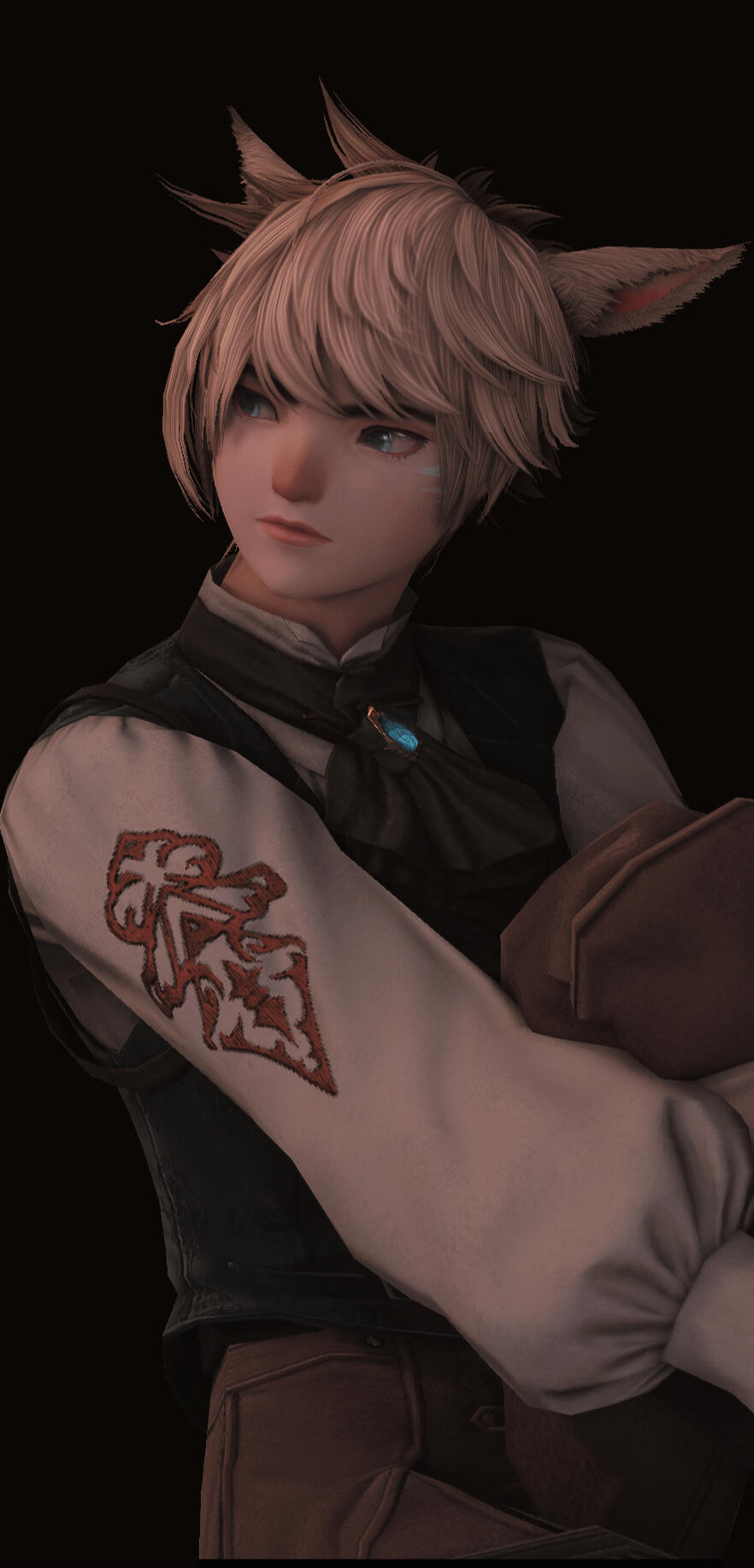
Quick Facts
Has an unhealthy understanding of many occult traditions and a knack for ritual. Demonology is his ‘special interest’ subject.
Heir-apparent to the House of Page: a respectable La Noscean family and holders of the governorial seat on the Vylbrandian Isle of Tuhl.
Solomon's mother, Lady Guinevere Page, is the aforementioned governor and presiding head of the family.
Has two younger sisters (currently npc's) that he thinks will surely invent time travel since they clearly went back to put the sun in the sky. One has already made it to university and is a budding genius herself.
Fellow-Magus & Alumni of the La Noscean Admiralty Academy of Arcanima and Natural Philosophy where he spent much of his adolescence studying the arcane.
Was 14 when the last Calamity hit (mid-20's now, I use the year-per-expansion rule), which saw him and his friends enlist in military free companies at the time, cutting their teeth on the arcane in a sundered world.
'Neo-practicism' is a (headcanoned) philosophical model in demonology regarding how he categorises and approaches 'Outside' forces, which divides them into the 'Upper Hells' (the Void) and the 'Lower Hells' (any other alternate dimension). He refers to all of these entities interchangeably as demons, daemons, outsiders, neighbours, or whatever sounds coolest at the time.
'Knight Philosophus' of the Poor Fellow-Magi of St. Saerwyth and the Order at Oldcross House - a secretive, hermetic group of magi and occultists organised into a quasi-knighthood [I'm the OOC creator and leader of the group].
The Knightly Occult.
Maybe you're close to uncovering or have uncovered some arcane secret or treasure, or maybe you're an occultist working on something rather 'bleeding edge.' Enter Solomon, a member of an obscure, hermetic order of arcane practitioners (see: oldcross.crd.co) who'd just love to get their hands on whatever you have, or maybe make you a colleague.
The Consultant.
Someone you trust introduces Solomon as a “specialist.” He’s polite, affable, a little too young for his reputation, and far more interested in watching than intervening. When the problem is resolved, you realise you were never really the client.
After-Dinner
Amusements.
You’re invited to a salon where dessert is followed not by music, but by a demonstration: the tables are moved out of the centre of the room and Solomon begins working a ritual circle into the floor. He needs a volunteer to be the conduit of a key node. You end up raising your hand or he selects you and you become part of the demonstration.
My Name is Red.
Solomon occasionally produces his grimoires as illuminated manuscripts with its borders in the style of Ottoman miniaturist art. You end up stumbling on a copy of one of his by some happenstance. The scene depicted violates every rule of miniature perspective. Eventually, you recognise the trick: the image is mapped to ritual positions, not visual space. And before long, he comes looking for it.
Once More,
Unto the Breach.
You’re investigating Solomon Page’s activities with the Eorzean Alliance on the Bozjan-Dalmascan Front. You mention his name in passing and the reaction is immediate: a flinch and sudden eagerness to change the subject. No one will say what happened, only that “he did his job properly,” (and that they hope he never has reason to do it again). The catch: he was the last person seen with someone very important to you, either professionally or personally.
Demonologist,
The Courteous Leash.
Secretly, Solomon keeps a handful of 'retainers' - carefully thrice-bound to a host of his make. It might be a little humiliating, being coaxed around by someone who looks like a particularly aggressive spring breeze might knock him down, but he’s polite and respectful and asks surprisingly little. He even talks to you like an equal, though maybe that’s pretty unintentionally insulting for someone of your lineage. He does, however, expect you to behave out in public.
Peer Review.
You publish, teach, or circulate something arcane and receive a meticulous critique in Solomon’s hand. It’s as fair and insightful as it is… damning. At the end is a single line: “If you’d like to see what happens when this goes wrong, I can show you.”
Field Notes.
You find a notebook dropped or forgotten — diagrams, cramped annotations, speculative conclusions. One page is devoted entirely to your recent behaviour, charted with unsettling accuracy. When confronted, Solomon is genuinely embarrassed. “Ah. Yes. Those were only meant to be internal.”
A Jumble of
Sparknote Hooks.
University study-buddies & rivals; Solomon the Exorcist; old ex-lovers prone to bickering; the demon he'd bound into a severed hand / mirror / dinner fork gets unruly and wouldn't you know it, you're right there when it happens; family members; Solomon the Tutor; the witch-hunter gets wise to Solomon’s bullshit.
Characteristics
| Scholarly | Opportunistic | Curious | Arrogant |
| Show-off | Playful | Pervy | Polite |
| Deceptive | Sensitive | Reckless | Ambitious |
| Famous | Tainted | Clumsy | Traumatised |
Biography
For people who want the more long-winded (but certainly still fairly abridged) version of Solomon's biography, from a La Noscean governor's son to a Limsan arcanima academy, war, and beyond. However, to get a more visceral taste of this, the 'Stories' link at the top of the page might be useful!
Philosophies
Ever wanted to know what a Freislerian Custodian, Arcane Territorialist, or Neo-practic is? Oh. No? Well, that's unfortunate, cause...
Publications
It should be noted that the list of academic publications attached to Lord Solomon Page consists mostly of knowledge collated together from already-public sources for: ease of use; cultural localisation; ethical considerations; the marginal expansion on certain subjects; or tying rarely-connected studies together. This is typical of his bloodline which, although filled with skilled and decorated magi, continues to hold a reputation of being staunch, arcano-academic conservatives and traditionalists celebrated by political factions within Limsa that favour an expansionist, magocratic La Noscea.
Laws of Mythopoeia
A series of magical laws that govern a lot of Solomon's work and which he impresses upon members of his atelier to include in their own. I think Crowley-type hermetic traditions are pretty neat and it probably shows! The twelve laws are a bit of a work in progress, though, hence why some are quite a bit thinner.
Biography
The Page Family is a known quantity in Vylbrand. As holders of the governorial seat on the La Noscean Isle of Tuhl in the Strait of Merlthor, that was to be Solomon's future as the eldest to Guinevere Page. At ten, he went to study at the La Noscean Admiralty Academy of Arcanima and Natural Philosophy in Limsa, but at fourteen, the Calamity hit, the silver spoon fell from his mouth (solid, final thud), and he was promptly enrolled in the school of hard knocks.Things were so much more chaotic back then: the moon falling; the shelling and endless fire; the awful silence. So with the star torn asunder, maybe the powers that be looked the other way when a boy but fourteen years old marched into the world of condottieri and landsknecht to stand shoulder-to-shoulder with those twice his age, running (stumbling) into the fray.And being a prodigy was supposed to be easy, but they said it would be a great adventure and that they would do great things - that they should be proud. The story book is waterlogged and stained in some gutter, now, though.It's not until nineteen that he sees his mother, his father, his two little sisters, baby brother, and dozens of cousins again, but by then it's too late, he'd lost the ability to sit still because he'd only learned how to make his head a vacuum by drowning it in noise - by never stopping. He will say that it was the world that did the breaking, not him; all he’s done is simply adapt to the curve.Four years later, he lives in the Limsan estate of his first cousin, once removed, and still writes about a dozen family members every month, but he makes sure he's never catching his breath. It’s easy with his penchant for delving into the deep maws, fathomless depths, and Old Bones of the earth. That’s where they keep the Good Books, after all: the ones about Long-Limbed Neighbours and Ever-Smiling Chaperones; the ones that read you far quicker than you read them. It’s just his special interest, though, that’s all.He’d really rather like to go ballroom dancing, too.
Philosophies
“Ugh. Oh yeah, the date was going great, honestly, at least until I learned he was a Custodian.” / “Custodian? Of what? And why’s that a problem?” / “Capital C.” / “Oh. Ohhhhhhhh. A Freesbee. Guh-roooooooooss.” / “Right? So archaic. Probably dances around in funny hats, too.”
Freislerian Custodialism. Named after the movement's founder, Custodians believe that magic should be used for the betterment of society as a whole, but not necessarily via sharing its lore. They argue that total dissemination is liable to do more harm than good, and that it is instead the duty of trusted, proven, learned magi and sages to work it safely.Arcane Territorialist. Territorialists are chiefly concerned with their central, oftentimes zealous belief that a mage has a right to protect their intellectual property. Additionally, they often push for laws granting greater sovereignty over their “tower enclosures” (whatever primary residence and grounds they conduct their magic in) on the basis that, since spellwork has a tendency to alter the laws of physics in their domain, they see no reason why it shouldn’t alter the laws of the land, too.Neo-practicism (Demonology). Neopractics choose to embrace the “beautiful pageantry” of extraplanar worlds as a topic worthy of study and appreciation, while still stressing the fact that dealing with their residents should be done only when absolutely necessary (such as when they are already in our world), from a purely professional standpoint, and with assumed (though they would hazard to say 'factual') hostility. Although a neopractic prefers to eschew arbitrarily-weighted phrases like “good” and “evil” due to being universal abstracts, they often insist that interdimensional diplomacy should consist largely of “maintaining borders” and keeping both sides in their own ponds, believing that one need not hate them to still accept certain cold, hard truths: that whatever small chance one might find a glimmer of likeness or commonality is not worth the damage of trying; that the vast majority of demons are far more interested in using us and then eating us when our use runs out than being our friends; and that although some of them may choose to look like us, act like us, sometimes even almost think like us, they are not us… and they do not belong here. Conveniently, Solomon is adept at doing mental gymnastics to rationalise why he should be afforded dozens of exceptions.
Academic Publications
The list of academic publications attached to Lord Solomon Page consists mostly of knowledge collated together from already-public sources for: ease of use; cultural localisation; ethical considerations; the marginal expansion on certain subjects; or tying rarely-connected studies together. This is typical of his bloodline which, although filled with skilled and decorated magi, continues to hold a reputation of being staunch, arcano-academic conservatives and traditionalists.
Demonology is a Social Science; an introductory primer on Neo-practicism for Eorzean sympathies
Written by “Suleyman Bey” (most likely Solomon) under the guidance of Emre effendi, the book attempts to make a case for the superiority of the "Neo-practic approach" (occasionally referred to as the “Dalmascan method”) to Demonology over that of the Sharlayan model, including the rungs system. According to Suleyman, its attempt to make a purely-practical system of categorization, leads to it being hamstrung and inaccurate both literally and practically. It suggests that, since the demon’s greatest weapon is knowledge, by demonstrating your own over its actual structure, culture, hierarchy, and spiritual sympathies puts it immediately on the backfoot and less certain it can exploit your ignorance. Beyond the practical side, it goes out of its way, on numerous occasions, to discuss the “bright, vivid, and breathtaking pageantry” of many of its fiefdoms and duchies, and that the pleasure of that knowledge and experience makes knowing worthy in and of itself, to not be broken down into “yet another” simple twelve-step program.
Fire, Water, and Blood; on the three great conduits of sorcery
Synopsis pending.
Mehmedi’s Cage; the role of time and Hawker’s Theorem in condensed, aetherial spaces
Unlike many of the other publications, this one was potentially quite groundbreaking– potentially, because a few hours after submitting it to the Admiralty Academy, he sent in a request to have it removed, and so all that remains is the name in the logbook.
Saints and Spell-Salvos: State Worship and Sainthood in the Demarchist Republic of Ismyrna
An ethnography regarding the role of the state, state-approved sainthood, and magocratic jingoism found in the island-nation of Ismyrna, and on how its republic turned rapidly autocratic under its charismatic leader, Kiamke Zavoi.
The Lovebinder’s Paradox; when freedom becomes a new hell, don’t expect them to thank or forgive you
A treatise on the danger of freeing someone from love potions, charms, and enchantments meant to romantically ensnare another, and how the ‘love,’ fabricated or otherwise, feels no less real to the individual, and losing it no less painful– or even more painful due to how rose-tinted and perfect it's designed to seem.
It’s All a Bad Dream: a cautionary tale on astral resonance & planar asynchronism
Synopsis pending.
The Real Devil is Beautiful; rhetorical apologetics in defense of demonology
Although the author emphasises the importance of removing moral judgments from entire disciplines of magic, he uses enchantment as ‘debatably’ (for rhetorical purposes) a far more heinous form of magic than demonology has ever been, as it violates an individual's mind and strips them of the basic, inalienable right of ‘choice.’ It makes extensive use of visceral parallels.
You Can’t Save Them All; or the pitfalls, pains, and personal purgatories of divination
Synopsis pending.
A Broken Nose and No Family; a treatise on the impact of youths in isolation within the framework of post-Calamity free company service
Synopsis pending.
Laws of Mythopoeia
"...it's a cornerstone force in magic, derived and given form through belief and the ability of mankin minds to impose that belief on reality. When you weave with the arcane, you are... in a sense, creating minor myths and miracles: stories that originally may or may not have been true, but you've convinced or bargained or coerced reality into seeing things your way. You could say that some forms of magic are really just lies told so well that even reality buys into it. It's all about learning the imperfections of the cosmos' memory. After all, if you win the metaphorical debate, there's no difference between the reality that was and the reality that now is, so much so that it Becomes recursively: always so."
—Knight Philosophus Solomon Page
law of correspondence
"As above, so below."
Reality is not composed of isolated strata, but of repeating structures at different scales, expressed fractally: the motions of stars echo in blood, the architecture of nations repeats in the body, and the soul is not a metaphor but a smaller iteration of the world. Correspondence magic, when performed correctly, should feel inevitable: you aren't forcibly imposing your will on reality, but instead simply revealing the way it already wanted to behave, and giving it the permission to do so.
law of sympathy
"Like affects like."
Similarity is not superficial but instead a sign of shared essence; things resemble one another because they emerge from the same metaphysical source; to act upon one is to disturb the underlying quality they both express. Sympathetic magic is about family pressure whereby the magus persuades reality by appealing to kinship.
law of contagion
"Intimacy outlives distance."
Because time and distance are often an illusion, sustained contact with an object establishes a permanent metaphysical relationship with it unless explicitly and intentionally severed through ritualistic means. The universe is a tireless lover that aches for harmony, for intimacy, for oneness, and it is not often willing to let things go so easily. Magic operating under the law of contagion is all about using history and context to remind a thing that it's past is never gone, merely forgotten.
law of names
"Definition anchors dominion."
A name is both compressed definition and anchor - points where meaning crystallizes and fixes identity in a fluid universe that would otherwise allow endless drift. When a mage names something correctly, they are not commanding it, but are instead agreeing with it so precisely that disagreement becomes impossible, becomes unwriting. To know a true name is to know how a thing understands itself, but even false names, if used consistently and en masse, can still carry potency because reality prefers coherence over truth.
law of will
"Power flows where intent is unbroken."
Will is more about the coherence of purpose over time than brief, flickering desire. The universe is filled with competing intentions and many of those cancel one another out, but magic rewards the sustained pressure gradient of a mind that does not fracture under doubt, contradiction, or fear. This law explains why discipline outperforms talent, and obsession outperforms brilliance.
law of thresholds
"Power gathers at crossings."
Magic exploits indecision. Moments and places of transition where one state becomes another are zones of ontological looseness where reality has not yet decided what it is. In crossings, thresholds, and liminal spaces where thousands of ideas are constantly passing through, the world is already negotiating with itself. The mage simply joins the argument. This is why rites cluster around beginnings, endings, initiations, wounds, and borders: change is easiest where change is already occurring.
law of form
"Shape governs function."
Form is not merely cosmetic and meaning emerges not from freedom, but from limitation. The structures imposed on a Work via geometry, posture, and pattern tell power how to move and behave, and create potency through the congruity of form and essence.
law of custody
"Secrecy preserves potency."
Knowledge diffuses when shared as each retelling introduces variation, skepticism, and misuse that further confuses its design. Silence concentrates meaning and gives it its sharpness, whereas forcing it to accomodate all interpretations leave it dull.
law of recurrence
"The cosmos is a forest; our magic makes the path."
Reality learns: each event leaves a faint trace, creates a preference, whispers a suggestion. Repetition codifies miracles into Law.
law of dissolution & reconstitution
"To remake, first unmake."
Every alchemist knows that incompleteness is a necessary phase, not a failure, and every Ruling King must learn that this, too, is the thermodynamics of the soul. Transformation requires loss of structure as old forms resist change and must be broken down into its basic components to be reformed without impurities.
law of witness
"Many minds, one horizon."
The cosmos is a single, continuous being in the act of becoming, and humans are not external observers of this whole, but localized points at which the universe becomes aware of itself. To have them witness, then, is to participate in meaning, to be the apparatus by which it collapses the potentiality of reality into narrative, thus forcing the universe into consensus with itself. A practitioner must take care with their chosen witnesses, then, since an observer contributes interpretation, memory, and expectation to the Work, adding unique colour and texture, and so: many minds, one horizon.
law of sacrifice
"Sacrifice repeats the first story."
The full depth of Sacrifice is either poorly understood or incomprehensibly layered. In some situations, it operates as the spiritual analogue to the alchemist’s equivalent exchange: reality abhors incongruity and so to get you must first give. In other traditions, it exists to violate boundaries and fray the structure of reality and thus make it more malleable. It compresses meaning, focus, and intensity to generate metaphysical density. And this, of course, adds gravity and prestige to the narrative-driven cosmos we belong to.
Screenshots by Me


Screenshots by Others

by tatl

by tabbycat

by tatl

by tatl

by tatl

by tatl

by tabbycat

by tatl

by tabbycat

by tatl

by beebopia


things i love
headcanon, worldbuilding, enthusiasm, and gushing about character stuff together
high fantasy in a middle ages-to-regency sense; low, punishing, addictive, or imperfect magic; low tech
horror, ritual, horrific rituals, occult, weird reality-bending stuff, endless hallways and bottomless ruins and the price of hubris
thoughtful inventive characters with really honed-in aesthetics
being 18+ irl required, 25+ strongly preferred; i don't care what your character's age is, but it might understandably change the ways mine interacts with yours
adding people to discord. i play a lot of characters and hop between them a lot, so it's a good way to collaborate and avoid constantly becoming 'two ships passing in the night'; if I'm AFK, though, feel free to send me, like, your carrd url and discord name if you want and I'd be happy to add you when i return.
also be nice to me, it’s the law
please, no
ooc capitalists/libertarians, fascists (includes being pro-Israel, pro-police, pro-state), misogynists, transphobes, you get it
being way too discourse-heavy about rp; most of my characters are not good people, i know that, there's nothing to discuss there
style over substance; conversely, substance without style
openly 'unhinged' characters. with the exception of demons or as a path to something, i can't see why solomon would associate with serial killers and the like, so don't be too openly that i guess
overly-grizzled characters that've 'seen it all.' i'm a horror writer and he's a demonologist - if you don't immerse yourself in the fear occasionally, that ends up boring for me.
too much tech / modern stuff, inclusive of: modern clothes, modern weaponry (if it’s not muzzleloaded it’s probably a no), anything with digital lighting or could even tangentially fit into the statement ‘oh i just casually have this allagan / sol9 whatever lying around’; happy for some garlean up-to-dieselpunk stuff, but know that solomon hates magitek and will mock you behind your back for using it
emphasis on too much; i don’t mind this stuff in moderation, it’s more when a character’s whole aesthetic fits into this, it’s just too outside of his scope